
 While Tokyo is now the capitol of Japan, Kyoto held that title for over a millennium from 794 CE to until 1968, and there is no denying that the ancient and imperial history of this beautiful city is still a celebrated and significant part of what it means to be in Kyoto today. Visitors to the city will no doubt be impressed by how technologically and architecturally advanced Kyoto has become, but there is much to be said for a trip which highlights the historical and gives us pause to consider the past. With an abundance of temples, shrines and palaces, Kyoto is brimful of landmarks and monuments that each have a special story to tell.
Table of Contents
Kinkaku-ji or the Golden Pavilion
One of the most photogenic structures in Kyoto, the Golden Pavilion is a three-story Zen Buddhist temple that sits peacefully and harmoniously on a pond where, during clear weather, a perfect reflection can be seen. The temple was built originally as a villa before it was purchased in the 14th century and turned into the Kinkaku-ji complex. While the current building is a reconstruction, the gardens are original and follow the Muromachi period garden design, which seeks to shrink down larger landscapes to fit a smaller setting.
Tenno no Mori Tumulus
This ancient structure in Kyoto City was built in the fourth century, “tenno no mori” translating roughly into “the Emperor’s Grove,” referring to the burial mound of Emperor Junnin, and the largest of its kind at 83 meters long. Excavation turned up earthenware sculptures embedded into the rim of the circle.
Kiyomizu-dera Temple
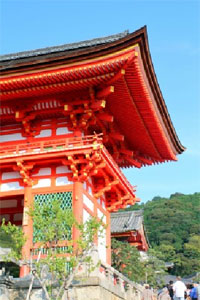
Translated, Kiyomizu-dera means “Pure Water,” and this temple is perhaps the most-visited attraction in Kyoto, with about four million people coming to see it every year. A priest by the name of Enchin had a dream where he was instructed to go to the Kizu-gawa river and find a “fountain of pure water.” He met a Buddhist recluse named Gyoei Koji, who gave him a block of wood which Priest Enchin carved into a statue of a Buddhist deity and then enshrined. Two years later, Priest Enchin was still at the foot of the mountain Otowa when a military general came upon him. The military general was moved by and devoted to his teachings, and then endowed Enchin with what is considered the earliest structure of the Kiyomizu-dera Temple.
Today the temple inhabitants consider it the headquarters of the Kita-Hosso-shu sect. Visitors who come to Kiyomizu-dera might be surprised by the walkway leading up to the building, which is a hive of activity – vendors, refreshments and souvenirs.
Nijo-jo Castle
In the center of the city, the Nijo-jo Castle is another of the most popular sights in Kyoto, even though it is surrounded by a moat and tall stone walls which would suggest the inhabitants were once trying to keep people out. It was once the power base of the Tokugawa Ieyasu, a 17th century shogun who did not shy away from showing off his wealth. Like a lot of the structures in Kyoto which are damaged and rebuilt, Nijo-jo Castle’s tower was reduced to ashes by fire (of lightning!) in the mid-18th century. The castle boasts fine gardens, ornate inner rooms and a low-tech but ultimately impressive defense mechanism: squeaky floors built into the reception rooms, so that no one could sneak up on the castle’s inhabitants.
Kyoto Imperial Palace
Entrance is free to the Imperial Palace, and although English tours only run from 10 a.m. until 2 p.m. Monday through Friday, it is still well-worth a visit. The existing construction is only from about 1855, and the Emperor is rarely in residence, but the Imperial Palace is nonetheless a fascinating way to experience the grandeur and ceremony of the Japanese Imperial family and court as it was until 1869. Tours can be arranged to view the ponds, gardens and exteriors, though not the interior rooms.
Higashiyama
The Higashiyama ward, or neighborhood, of Kyoto is an entirely historic area between the Kamo River and the Higashiyama mountain range. Higashiyama Bunka is the formal name for a type of Japanese culture which the 15th century shogun Ashikaga Yoshimasa founded, and the wabi-sabi aesthetic (beauty in simplicity) can be found all throughout the neighborhood, from the temple Ginkaku-ji with its splendid garden to the aforementioned Kiyomizu Temple.
Heather McLelland is a contributing writer and social studies teacher who taught English to Japanese students for five years, after graduating from college.

Luca is a travel photographer and luxury explorer who brings destinations to life through curated guides and stunning visuals.